Cite this tablet
HT117a, side A. Haghia Triada, Late Minoan IB. HT Scribe 9. Edition: GORILA I (Godart & Olivier, 1976). Object record v[—]. [permanent URL]
tablet · side A
An interpretation — not a description of the object.
The photograph shows the object. The tracing is a scholarly representation of it.
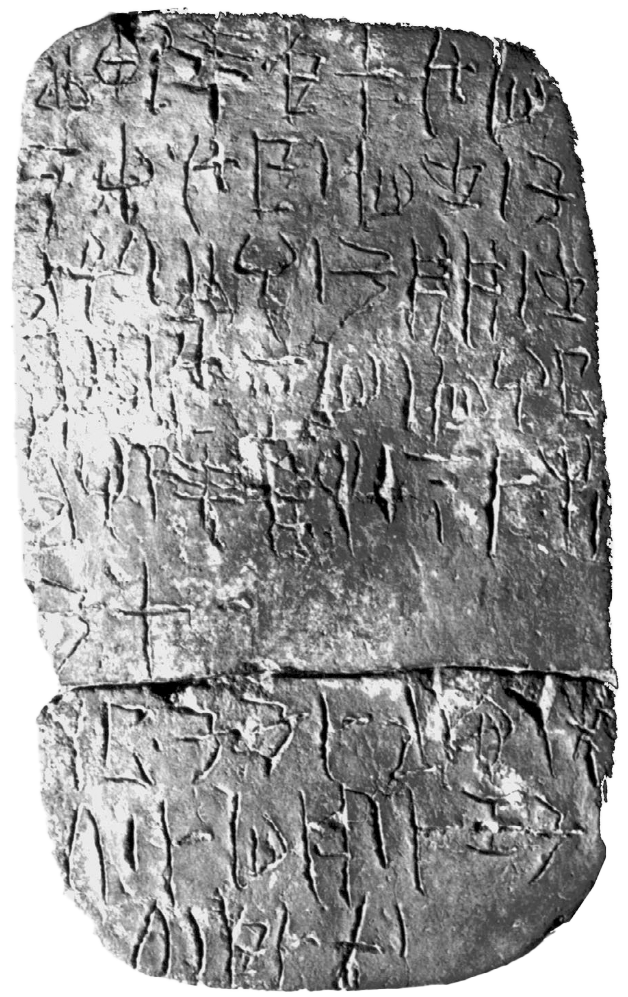
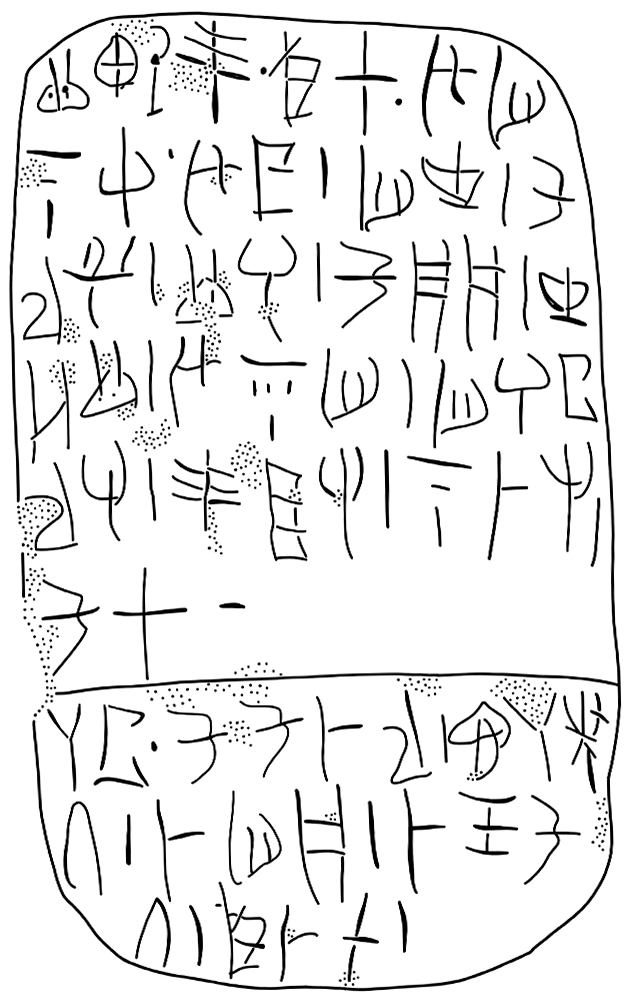
Linear A tablet HT 117 from Hagia Triada in south central Crete.Courtesy of the Program in Aegean Scripts and Prehistory Archives, University of Texas at Austin.Copyright © 2003 Regents of the University of California. All rights reserved.Tracing of HT 117a. Sign drawings from SigLA: The Signs of Linear A, a palaeographical database, by Ester Salgarella and Simon Castellan (https://sigla.phis.me/), licensed under CC BY-NC-SA 4.0.approx. 6.7 × 10.9 × 0.8 cm · Indicative frame: proportions, orientation and the position of any ruled line wait for the facsimile.
Analytic sign sequenceUnicode · not a facsimile
Section I
Section II
Dashed box: uncertain or unidentified sign, or a ligature without a Unicode form. Plain box with a code: identified sign with no verified code point.
01 · Clay
A clay tablet. Two sections, separated by a ruled line.
02 · Signs
Section I, entry I.1, enlarged: 10 signs. Shown in Unicode glyphs for analysis — compare them with the facsimile.
3 sign-groups, as grouped in the conventional transcription.
03 · Words · Read
The conventional transcription gives each sign a sound value, largely by correspondence with Linear B, and keeps the grouping of the edition. It suggests how the line may have sounded — not what it means.
ma-ka-ri-te·ki-ro·u-mi-na-si
04 · Words · Interpret Enrica Patria segments · reads
The conventional grouping stays where it is. The proposal below adds its own divisions, marked with a blue bar.
ma-ka-ri-te·ki-ro·u-mi-na-si
··
Disputed.Patria writes the heading “MA ka-ri-te . ki-ro . u-mi-na-si” (Reading p.16; Divinità p.3). No divider separates MA from ka-ri-te in the conventional transcription. Elsewhere (Reading p.3) she cites the group as ma-ka-ri-te (HT87,1-2 and 117a,1) while discussing the notched sign read ri.
| ma (inside ma-ka-ri-te) | logogrammáter | |
| ka-ri-te (inside ma-ka-ri-te) | khárites | |
| ki-ro | khḗroi | |
| u-mi-na-si | úmnēsis |
05 · Meaning in Enrica Patria’s reading
| MA | “Mother”máter |
|---|---|
| ka-ri-te | “thanksgivings”khárites |
| ki-ro | “indebted (debtors)”khḗroi |
| u-mi-na-si | “hymn of praise / song of praise”úmnēsis |
| “Thanks to MA, song of praise; all are indebted of one offering each”Enrica Patria’s reading. Patria's translation continues into the list of names (Reading pp.16–17). Italian version: “ringraziamenti a MA, inno di preghiera, debitori” (Divinità p.3). |
06 · Explore freely
Each row keeps things apart: the conventional sign-group, how Enrica Patria segments it, how she reads it, and its status. Select any sign or row.
| Entry | Status | Num | |||
|---|---|---|---|---|---|
| Section I in Enrica Patria’s reading: religious festival | |||||
| I.1 | MA | ka-ri-te | máter + khárites | |||
| I.1 | = conventional | khḗroi | |||
| I.1 | = conventional | úmnēsis | |||
| I.2 | = conventional | Ísos | 1 | ||
| I.3 | = conventional | Mítus | 1 | ||
| I.4 | = conventional | kálamos | 1 | ||
| I.5 | = conventional | Márōn | 1 | ||
| I.6 | = conventional | Kábarnos | 1 | ||
| I.7 | = conventional | Thṓumas | 1 | ||
| I.8 | = conventional | Ídmē | 1 | ||
| I.9 | mi-ru-ta | RA | RE | merítai + Rã + RE | 1 | ||
| I.10 | corpus layers differ | te-ja | RE | Theía + RE | 1 | |
| I.11 | Na-da | RE | Náda + RE | 1 | ||
| I.12 | = conventional | kŷros | 10 | ||
| Total check: 1 + 1 + 1 + 1 + 1 + 1 + 1 + 1 + 1 + 1 = 10; ku-ro 10 — balances (lineara.eu) | |||||
| Section II in Enrica Patria’s reading: list of contributors | |||||
| II.1 | = conventional | sáton (n. pl.) | |||
| II.2 | — | [reading — to enter] | 1 | ||
| II.3 | Ko-sa-no | TI | Kursános / Kósanos + TI | 1 | ||
| II.4 | DA | minu | Dã + smḗnos | 1 | ||
| II.5 | da-jo-ku | TI | Dēíochos + TI | 1 | ||
| II.6 | — | [reading — to enter] | 1 | ||
Entries in this site’s order; edition line numbers still to be aligned. A row with “—” has no alternative recorded; “[reading — to enter]” marks a reading not yet entered.
Inspector
Select a sign or a sign-group to separate what the edition records, the conventional transcription and what Enrica Patria proposes.
A pattern in Enrica Patria’s reading
Linguistic units that combine logographic and phonetic signs.
On HT117a: 4 sign-groups. The conventional group is always shown first.
07 · Why? · the argument, step by step
AB80 opens the conventional sign-group ma-ka-ri-te.
No divider separates MA from ka-ri-te in the conventional transcription.
MA ka-ri-te . ki-ro . u-mi-na-si — MA is written as a unit of its own.
MA is the logogram of máter, an epithet of the Great Mother; ka-ri-te is khárites: “thanks to MA”.
Other attestations Patria cites for MA as a logogram: AMA, “royal (A) mother”, on MA1b; MARE, “RE of MA”, on HT55a,1; MA at the head of HT87.
ma, first syllable of ma-ka-ri-te.
Proposed segmentation; it depends on accepting logograms inside conventional sign-groups.
Enrica Patria
Patria, Reading Linear A before translating it — p. 16 (HT117a heading); p. 16 (HT117a heading); p. 12 (HT117a,1); p. 16 (HT117a heading); p. 12 (MA1b); p. 13 (HT55a,1)Patria, Divinità minoiche, 2024 — p. 3 (HT117a heading); p. 3 (HT117a heading); p. 3 (HT87, MA1b)
Enrica Patria Pugliese
Patria, Linear A between sound and meaning, 2025 — p. 10 (HT117a heading); p. 10 (HT117a); p. 10 (MA1b); p. 13 (HT55a,1)
AB27 (re) closes three conventional sign-groups in section I: mi-ru-ta-ra-re, te-*56-re, na-da-re.
In lists totalled together with the pictogram HOMO (HT27a, 89, 94a, 100), RE occupies the same position as HOMO; Patria reads it as a logogram for a type of men.
RE follows names of divinities: on HT117a Náda (a nymph), Theía and Rã / Réa; elsewhere DA, MA, Baía and the royal Rḗnē.
Na-da | RE · te-ja | RE · mi-ru-ta | RA | RE
RE means “attendant”, “priest” or a comparable cult official — “certainly a high-ranking official”. Possible etymological parallel: Greek leússō, “to see, to pay attention”.
Some RE compounds became personal names in Linear B (Pa-ja-ro, Te-ja-ro, A-ra-na-ro); they may be theophoric names formed with a deity's name.
re is the final syllable of each sign-group.
Proposed reading. The pattern is compatible with both readings; it does not prove either.
Enrica Patria
Patria, Reading Linear A before translating it — p. 13; p. 11; p. 11; p. 13; p. 13; p. 14; p. 17 (HT117a, first list); p. 14; p. 14Patria, Divinità minoiche, 2024 — p. 4 (n. 18); p. 4 (n. 18)
Enrica Patria Pugliese
Patria, Linear A between sound and meaning, 2025 — p. 8; p. 8; p. 13 (Hybrid words formed with RE); p. 13 (HT117a,5; HT117a); p. 8; p. 13
HT117a contains the conventional sign-group da-ne-ku-ti. Its second sign is AB24.
da-[AB24]-ku | TI — TI is a logogram placed after the term it refers to.
HT93a,6: de-ju-ku, with AB65 (ju) where HT117a has AB24.
de-ju-ku and da-jo-ku are variants of one personal name, Dēíochos (also in the Iliad, XV 341): congruent positions and the a/e, o/u vocalic instability of Linear A.
AB24 = jo, giving da-jo-ku.
In the GORILA 5 sign lists AB24 is in final position in 70% of cases, comparable with ju (57%) and ja (37%).
By Linear B correspondence, AB24 conventionally receives the value ne.
Disputed / proposed sign value. Neither reading is presented here as settled.
Enrica Patria
Patria, Reading Linear A before translating it — p. 4 (da-*61-ku (117a,8) / de-ju-ku (HT93a,6)); p. 12 (HT117, line 8); p. 4 (HT93a,6); p. 4; p. 15; p. 4
Enrica Patria Pugliese
Patria, Linear A between sound and meaning, 2025 — p. 2 (HT93a,6 / HT117a,8–9); p. 3; p. 4 (summary table); p. 2 (HT117a,8–9); p. 2 (HT93a,6); p. 2; p. 4 (summary table); p. 2; p. 3
Convention
Standard convention; a citable reference is still to be chosen.
AB37 (ti) closes two conventional sign-groups in section II: ko-sa-i-ti and da-ne-ku-ti.
Used as a logogram, TI is always placed after the term to which it refers.
KN1 records on each side a person followed by TI and a quantity of the substance E (240 and 105 units), read as two completed payments.
MA1, a record of a cultic offering without figures, has TI on side c, confirming that the offering was completed.
Ko-sa-no | TI · da-jo-ku | TI
Two contributors, Kursános / Kósanos and Dēíochos, have already paid their share.
ti is the final syllable of each sign-group.
Proposed reading. On ko-sa-i-ti it also requires reading AB28 as no.
Enrica Patria
Patria, Reading Linear A before translating it — p. 12 (HT117, lines 7-9); p. 12; p. 12 (KN1); p. 12 (MA1); p. 12 (HT117, lines 7-8); p. 12 (HT117, lines 7-9)Patria, Divinità minoiche, 2024 — p. 3 (MA1c); p. 3 (MA1)
Enrica Patria Pugliese
Patria, Linear A between sound and meaning, 2025 — p. 6 (HT117a, second list); p. 6; p. 6 (KN1); p. 6 (MA1); p. 6 (HT117a, second list); p. 6 (HT117a, second list)
The heading of HT117a writes u-mi-na-si with four signs: AB10, AB73, AB06, AB41.
The same term appears as u-mna-si (HT15,1; etc.), written with AB34.
]pi-mi-na-te (APZa2,2) / pi-mna-te (HT116a,4).
Both u-mi-na-si and u-mna-si appear in the headings of accounting lists; the i of u-mi-na-si renders an anaptyctic vowel.
AB34 seems to represent a stylized lunar symbol, Greek mḗnē, “moon”.
AB34 = mna; u-mi-na-si / u-mna-si = úmnēsis.
No conventional value for AB34 is recorded on this site yet.
Proposed sign value.
Enrica Patria
Patria, Reading Linear A before translating it — p. 3 (u-mi-na-si (HT28,1-2) / u-mna-si (HT15,1)); p. 3 (HT15,1); p. 3; p. 16 (n. 52); p. 3
Enrica Patria Pugliese
Patria, Linear A between sound and meaning, 2025 — p. 4 (u-mi-na-si (HT117a,1–2) / u-mna-si (HT15,1)); p. 4 (HT15,1); p. 4; p. 8 (n. 3); p. 4; p. 4 (summary table)
08 · Network
Related records, from the claims on this page — not a chain of cause and effect.
Cite this tablet
HT117a, side A. Haghia Triada, Late Minoan IB. HT Scribe 9. Edition: GORILA I (Godart & Olivier, 1976). Object record v[—]. [permanent URL]
Cite this reading
Patria, E. “HT117a: a reading.” Reading v1, [year]. In Linear A — Research by Enrica Patria. [permanent URL]
Primary edition
GORILA I, Louis Godart & Jean-Pierre Olivier, 1976
Digital corpus
SigLA: The Signs of Linear A (Salgarella and Castellan)lineara.eulineara.xyz (Robert Hogan)
Thomas G. Palaima
Palaima, “Archaeology and Text: Decipherment, Translation, and Interpretation”, in Theory and Practice in Mediterranean Archaeology: Old World and New World Perspectives (2003), 2003
Enrica Patria
Patria, Reading Linear A before translating itPatria, Divinità minoiche, 2024
Enrica Patria Pugliese
Patria, Linear A between sound and meaning, 2025
Convention
Standard convention; a citable reference is still to be chosen.
Information still to be completed
Shown as visible placeholders, never filled in silently.